Changing Generations, Changing Real Estate Needs

October 19, 2026

What demographic trends could mean for retirement and estate planning

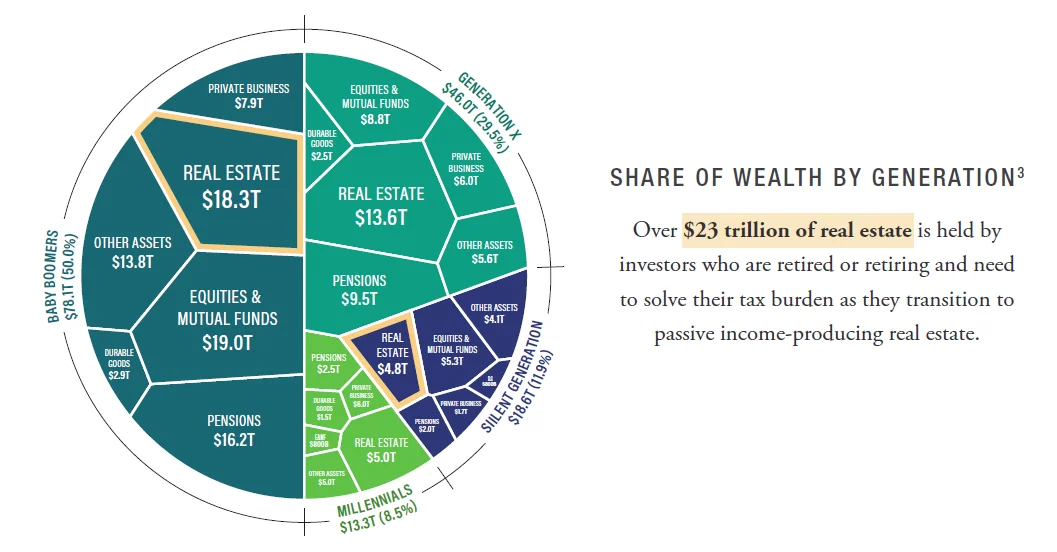
Over the next two decades, a significant amount of wealth is expected to change hands as Baby Boomers and the Silent Generation age and begin transferring assets to younger generations. According to ExchangeRight’s 2025 Demographic Outlook, these two generations hold approximately two-thirds of the nation's wealth, including more than $23 trillion in real estate. As more Americans enter retirement, the way they manage their investments and plan for the future may begin to change.

Real estate is an important part of this transition. Many investors have owned properties for decades, and those properties may have appreciated considerably over time. Selling a property can create tax considerations, including potential capital gains taxes and depreciation recapture. For individuals who are moving away from actively managing real estate, understanding the available options for managing these assets is an important part of retirement and financial planning.

A 1031 exchange is one strategy investors may explore when considering the sale of qualifying investment property. Under certain conditions, it allows an investor to defer capital gains taxes by exchanging one investment property for another qualifying property. A Delaware Statutory Trust (DST) is one structure that may be used in a qualifying 1031 exchange. DST investments allow investors to hold a fractional interest in real estate without directly managing the property. However, these investments have specific requirements, risks, holding periods, and liquidity limitations that should be understood before proceeding.

Estate planning is another important consideration as wealth transfers between generations. ExchangeRight estimates that approximately $75 trillion to $84 trillion in wealth could transfer to Millennials and Generation X by 2045. For families with real estate holdings, this makes it important to understand how property ownership, beneficiary arrangements, estate documents, and potential tax implications fit together. Planning ahead can help families understand how assets may be handled and transferred according to their wishes.

Retirement often brings changes in income needs, investment responsibilities, and financial priorities. Reviewing real estate holdings alongside retirement income planning and estate planning can help investors better understand their overall financial picture. Each person's circumstances are different, and decisions involving real estate, tax deferral, and estate transfers should be reviewed with qualified financial, tax, and legal professionals.

If you have questions about how changes in retirement, real estate ownership, or estate planning may affect your financial picture, contact Verus Financial Group to schedule a review with your advisor.

Source: ExchangeRight, 2025 Demographic Outlook. The demographic and wealth-transfer figures above are estimates presented in the source document, not independently verified projections.
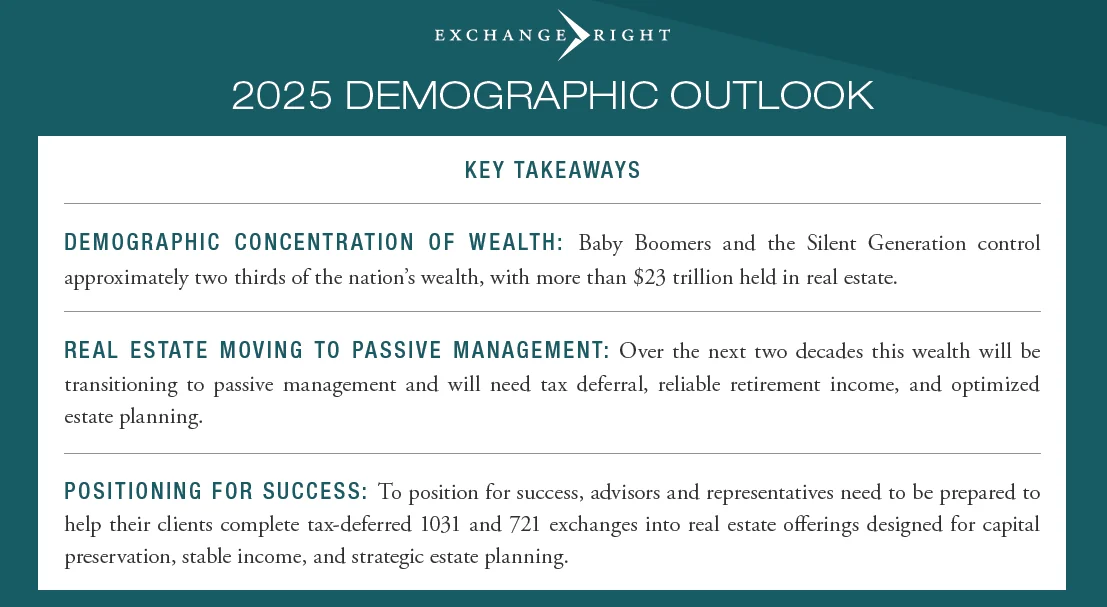
ExchangeRight 2025 Demographic Outlook key takeaways

The information presented in this article is provided for educational purposes only. The article includes a discussion of Delaware Statutory Trusts ("DSTs") and other real estate-related investment structures with ExchangeRight. The information presented does not constitute an offer to sell, or a solicitation of an offer to buy, any security, including any DST interest. DST interests are securities offered only pursuant to a Private Placement Memorandum to accredited investors and are subject to significant limitations. DSTs are not suitable for all investors and involve a substantial degree of risk. Verus Financial Group is not affiliated with and does not receive compensation from ExchangeRight in connection with the material presented here. Advisory services are offered through Verus Financial Group, an investment adviser registered with the U.S. Securities and Exchange Commission.
back To Blog archive

explore our financial info resources

A Look at ExchangeRight’s Investment Track Record

When reviewing a real estate investment sponsor, it helps to look beyond the stated goals of an offering. An investment track record can show how previous offerings performed, how long investors held them, and what…

Using a 1031 Exchange to Invest in a DST

Selling an investment property can create a large tax bill, especially when the property has increased in value over time. A 1031 exchange may allow an investor to defer capital gains and depreciation recapture taxes…

Why Investment-Grade Tenants Matter in Commercial Real Estate

When a commercial property is leased to a business, the tenant’s ability to pay rent is an important part of the investment. That’s one reason ExchangeRight focuses on long-term, net-leased properties with…

How Private Real Estate Has Performed Alongside Stocks and Bonds

A portfolio built around stocks and bonds may not be the only way to spread investment risk. Private real estate is another asset class investors sometimes consider. ExchangeRight’s overview looks at how adding…

Understanding the Benefits and Considerations of DST Ownership

A Delaware Statutory Trust (DST) is one structure investors may consider when selling investment real estate and completing a 1031 exchange. A DST can provide an ownership interest in a portfolio of commercial…

Real Estate and Retirement: Why Asset Allocation Matters

When reviewing an investment portfolio, age, income needs, and access to cash all matter. The same considerations apply to real estate. An investor who is still working and building wealth may have different…

Changing Generations, Changing Real Estate Needs

Over the next two decades, a significant amount of wealth is expected to change hands as Baby Boomers and the Silent Generation age and begin transferring assets to younger generations. According to ExchangeRight’s…

A Closer Look at ExchangeRight

When evaluating a real estate investment, it helps to understand who is managing the properties, what types of assets are involved, and how the investment is structured. ExchangeRight is a real estate investment…

Why Can't a High Earner Just Write a $40,000 Check to a Roth IRA?

Direct Roth contributions phase out well below this income — so the mega backdoor Roth is the workaround, when the 401(k) plan allows after-tax contributions and in-plan conversions. How the 2026 limits, after-tax room, and pro-rata rule really play out.

What Does a Fixed Index Annuity Actually Deliver When the Market Moves?

A fixed index annuity credits interest tied to an index — but caps, participation rates, and spreads mean you never capture the full return, and a down year usually credits zero. A grounded look at how the numbers work, the fees, and where the product fits.

What Happens to Leftover Money in a 529 if the Kid Doesn't Use It All for College?

Unused 529 money doesn't disappear — it stays invested and tax-deferred, can move to another family member, or roll into a Roth IRA for the beneficiary. A look at limits, superfunding, financial aid, and the penalty on non-qualified withdrawals.

What Breaks When You Put College Money in a UTMA?

A UTMA hands your child the money — and full control — at 18 or 21. How custodial accounts really work: irrevocable gifts, the kiddie tax, gift-tax limits, financial-aid impact, and how they compare with a 529.

September 2026 Insights

Your September 2026 roundup: a fall college-planning guide for parents (FAFSA, the CSS Profile, scholarships and true cost of attendance), a 1031 like-kind exchange course, Healthy Aging Month, an easy weeknight recipe, and our latest podcast episode with Julien Marion.

Real Estate Investment Trusts (REITs): Plain Talk on What They Are and How They Get Used

A plain-English look at REITs: the IRS rules that define them, return of capital, 1031 exchanges, 721 UpREITs, and why investors use them.

Private Credit: What It Is, the Main Types, and How It Differs from Regular Bonds

How private credit works, the main strategies—direct lending, mezzanine, distressed and special situations—and how it compares with publicly traded bonds.

What Are Private Equity Funds?

A plain-English primer on private equity: what these funds are, how general and limited partners fit in, and the three most common strategies—buyout, growth equity, and secondaries—with the pros and cons of each.

August 2026 Insights

Your August 2026 roundup: making the most of the Texas Tax-Free Weekend, a plain-English look at the new Section 530A “Trump Accounts” for kids, a creamy one-pot jambalaya pasta recipe, and Cyndi’s second entrepreneurial chapter.

July 2026 Insights

Your July 2026 roundup: National Financial Freedom Day and evaluating your financial goals, smart money habits for college students, a mid-year financial checklist, and a Red, White & Blue Tiramisu recipe.

June 2026 Insights

Your June 2026 roundup: National Insurance Awareness Day, a local guide to the FIFA World Cup 2026 coming to Houston & Dallas, and a Grilled Shrimp Panzanella recipe for summer.

May Insights 2026

This month we explore why tax diversification matters for retirement, three meaningful financial gifts for graduates and moms, the best May 2026 travel destinations, and a refreshing Mangonada recipe.

The Couple's Money Constitution

A free worksheet for couples to align their financial values, set spending rules, and build a shared money philosophy. Print two copies, fill them out separately, then compare your answers.

The Silent Divide: Why Every Marriage Needs a Money Constitution

After years of advising couples, the biggest threat to a marriage isn't a lack of love — it's financial silence. Here's the brutal truth about couples and money, and a practical framework to start fixing it.

April Insights 2026

This month we explore the hidden costs behind commission-free trading apps, what tax season can reveal about smarter year-round financial planning, plus a sweet carrot cake pie recipe.

March Insights 2026

We recognize the importance of diversity and the voices that strengthen our industry. As we celebrate Women’s History Month, we honor the women—past and present—who continue to make financial services more inclusive, innovative, and client-focused.Their contributions remind us that progress happens when people are empowered to lead, to question barriers, and to forge new paths.

2026 February Insights

Monthly Verus insights newsletter content with charity spotlight, planning checklist, recipes, travel ideas, and podcast updates.

THE SILENT PARTNER: WHY TAX DIVERSIFICATION IS THE ULTIMATE FREEDOM

How spreading wealth across tax-deferred, tax-free, and taxable buckets can improve retirement flexibility and tax control.

The Free Trading Mirage: Why Your Brokerage App Is a Casino in Disguise

A breakdown of gamified investing, payment for order flow, and the hidden incentives behind zero-commission trading apps.

THE LAZY MONEY EPIDEMIC: Exploring Better Ways to Put Your Money to Work

Why traditional low-yield cash habits quietly erode purchasing power, and what to do instead to actively pursue better yield.

COMMAND YOUR 2026: THE AI-ENHANCED BLUEPRINT

A tactical framework for using AI to cut waste, accelerate debt payoff, and redirect cash flow into long-term wealth building.

December 2025 Insights Newsletter

As we enter December, the countdown to December 31st is officially on. Before the year wraps up, now is the perfect time to finalize your financial checklist and make sure you’re taking advantage of every opportunity available for 2025. Here are the five key money moves to make before the year ends:

November 2025 Insights Newsletter

We're highlighting the Empower Walk & 5K Run, fueled by Autism Speaks—a signature event dedicated to improving the lives of individuals with autism.This event has evolved to include both a community walk and an exciting 5K run, but its mission remains the same: to create a more inclusive world. Every dollar raised provides vital support and drives innovative solutions.

October 2025 Insights Newsletter

Each October, organizations across the United States observe National Cybersecurity Awareness Month (NCSAM), a campaign led by the Cybersecurity & Infrastructure Security Agency (CISA) and the National Cybersecurity Alliance (NCA). Since its launch in 2004, NCSAM has worked to highlight how everyone — individuals, businesses, and governments — has a role to play in keeping the digital world safe.

September 2025 Insights Newsletter

Verus Financial is excited to shine a charity spotlight on Ronald McDonald House Houston volunteer opportunities.

August 2025 Insights Newsletter

Verus Financial is excited to shine a charity spotlight on Avondale House during the month of August with a Save the Date for their Bingo Bash.

July 2025 Insights Newsletter

This month of July, Verus Financial Group is proud to support Autism Speaks, a leading organization dedicated to promoting understanding and acceptance of autism.

June 2025 Newsletter

June Insights - Ready for Summer!

May 2025 Newsletter

May 2025 Insights

April 2025 Newsletter

April 2025 Insights.

March 2025 Newsletter

March 2025 Newsletter

February 2025 Newsletter

February 2025 Newsletter

January 2025 Newsletter

January 2025's Newsletter

2023 Webinar Line Up

We at Verus are still continuing to host educational and interactive webinars throughout the year so you can learn from the comfort of your home! Click to see the webinar links!

Strength in Houses

The extended strength of the US housing market prompted households to withdraw $82 billion of home equity in Q1, the largest amount in 15 years. Going forward, refinancing will likely be subdued as the average mortgage borrower has already locked in an interest rate over 200 bps below current rates. We believe that record-high levels of untapped home equity may add to the sizable savings buffer that households hold.‍

Your 2022 Half-Year Planning Checklist

As 2022 draws to a half, it’s time to begin organizing your finances for the second half of the year. To help you get started, we’ve compiled together a list of key planning topics to consider. Your Verus Financial Advisor can help you rebalance, review and reset your course, if necessary, for this year and beyond.

Where are we now in the market?

The market appears to be caught in a traditional growth scare if there is anything that is scaring the markets right now it's not just happening in US it's happening broadly as well. The roller coaster continues so we're seeing yields higher, and stocks lower and why that is happening we're actually going through a period of transition where the stimulus you know the sugar rush from stimulus is wearing off.

Estate Planning 101

A good estate plan helps ensure the right people will receive the right property at the right time. When you die, your assets are subject to a number of expenses that can significantly reduce the size of your estate left to your heirs. Proper estate planning can minimize these expenses and determine how the costs that remain will be paid.

Using Taxes to Your Advantage

Tax planning is the analysis of a financial situation or plan from a tax perspective. It is the reduction of tax liability by the way of exemptions, deductions, and benefits. The purpose is to ensure tax efficiency. Tax planning includes making financial and business decisions to minimize the incidence of tax.

Protecting Your Greatest Asset

To put it in simple terms, disability insurance is insurance for your income. It allows you to protect your most valuable asset, your income, in the event you become too hurt or sick to work. There are two options: Short-term and long-term. Analyze your existing coverage to find the plan that best fits your lifestyle! It can be more affordable than you think and the benefit can be used for different things such as medical expenses, household expenses, or help with household tasks. Most people protect their home, car, phone, and identity so why not protect your income.

Protect Your Loved Ones With Life Insurance

If you were to die unexpectedly, would your spouse have enough money to cover funeral expenses and daily living expenses? Would there be enough money to pay for everything your family relies on you for, if you were suddenly not around? Would your family have to move and change their lifestyle if you were to die prematurely? If your spouse were to outlive you by 10 or 20 years or more, would they be able to make ends meet? Life insurance pays cash to your loved ones after you die, allowing them to remain financially secure.

College is Right Around the Corner

Why Start Planning Now? A child that is born now will face tuition costs that are three to four times higher than what they are now. It is never too early to start planning for your child's future. There are many ways to save for college. Some you might have heard before, some you might not have. This article easily sums up different college saving plans that you can potentially think about using.

The Basics of Investments

What is Investing? Investing is the act of committing money or capital to an endeavor with the expectation of obtaining an additional income or profit. Making your money work for you maximizes your earning potential whether or not you receive a raise, decide to work overtime, or look for a higher-paying job. There are many ways you can invest which include putting money into stocks, bonds, mutual, real estate, or starting your own business. It does not matter which method you choose for investing your money, the goal is always to put your money to work so it earns you an additional income.

Why You Should Keep Investing Even When Markets Are Down

As investors during a decline in the market, it is difficult to remember why we decided to take the risk of investing. In its best days and its worst days, the stock market draws the most attention, but there is one surefire way to keep trading worth your time: Stick it out for the good and the bad. If you plan for the long-term, don't panic. Instead, here are 3 reasons to keep investing, even in the worst of times.

What does Fed rate hike mean for the market?

The big news today is that Chairman Jerome Powell and the Federal Reserves announcing a 25 basis point hike in interest rates. Let's see how this could potentially affect the market. If we take a look back at historical data, the S&P 500 has averaged a 3.7% growth, 12-months following the first rate hike of each cycle from 1971 to 2004. 24 months after the first hike, it has seen an average of 16.3% growth and averaged 31.0% after 36 months.

August Market Summary

GLOBAL EQUITIES: Q2 earnings data kept Delta variant concerns at bay, initially reversing the S&P 500’s mid-week decline. However, despite US Q2 GDP posting above its pre-pandemic peak, it came in lower-than expected, leading the S&P 500 to end the week lower by -0.35%. Meanwhile, Chinese stocks saw significant volatility as investors grappled with Beijing’s tighter financial regulations. The MSCI China Index ended the week lower at -6.06%. In the UK, a drag in the mining sector and variant concerns left the FTSE 100 up only 0.10%.

Mega Roth IRA: What It Is And How It Can Work For You!

Roth IRAs have been a popular topic as of late. For a long time, it was an unspoken secret used by retirement planners. However, the IRS released guidance that specifically addressed both backdoors Roth IRA conversions, and the so-called Mega Roth IRA. As a result, it has gained even more traction and interest.

Where Will Your Equity Profile Be in a Year?

The market is disengaged from financial fundamentals and all reality. Remember December 2018when the market fell 20% (over three months) over a “potential” China trade war? And remember the big rally in 2019 – and you’re saying to yourself “If only I had bought back then!” Surprise! You're getting a second chance!

What can we do for you with our houston-based Financial services?

Explore the various services we employ to see how we can improve your money.

plan

Your plan is more than just money; it’s personalized for you. We are side-by-side with you every step of this process to guide and help you create a custom financial plan based on your specific goals.

Retire

Imagine a retirement plan tailored for you. Everyone has a different money situation. That’s why you deserve realistic and personalized retirement plan to support your future.

Invest

For what matters most in your future. Saving for your goals and redirect your money away from companies with harmful products, policies, and practices.

protect

You are the most important resource to the people who depend on you. Our plans  designed to help you protect your loved ones whether it’s a child, an aging parent, or even a business partner and find clarity in next steps

Business coaching

Businesses deserve the guidance of a professional who understands not only its needs, but also how the business can affect a person's personal financial situation and life goals.

Coaching

You are your most important resource. Our executive coaching is designed to help you reinvent your career, create balance at work, and find clarity in next steps.