A Closer Look at ExchangeRight
When evaluating a real estate investment, it helps to understand who is managing the properties, what types of assets are involved, and how the investment is structured. ExchangeRight is a real estate investment sponsor that offers REIT, Delaware Statutory Trust (DST), and real estate fund investments. Its corporate overview describes a focus on long-term net-leased properties, with an emphasis on necessity-based retail and healthcare.
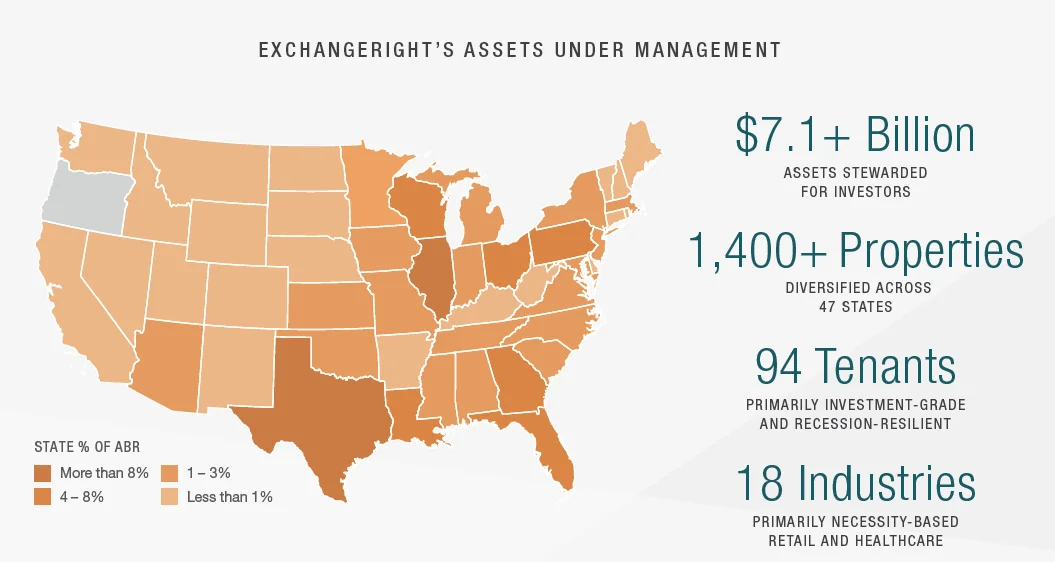
As of January 31, 2026, ExchangeRight reported more than $7.1 billion in assets under management, across more than 1,400 properties in 47 states. The properties had 94 tenants across 18 industries. The company says its portfolio focuses primarily on investment-grade tenants and businesses it considers recession-resilient. These figures reflect ExchangeRight and its affiliates and are based on the dates stated in its materials.
How the investment platform works
ExchangeRight describes its work in three parts: sourcing, syndicating, and managing real estate investments. Its team handles functions such as property and asset management, leasing, tenant retention, investor reporting, and transaction coordination. The company says this in-house structure is intended to support its investment process and investor services.
The company’s property strategy centers on long-term net leases. Under these leases, tenants are generally responsible for costs such as property taxes, insurance, utilities, maintenance, and repairs, as outlined in the lease. ExchangeRight says it reviews tenant operations, balance sheets, and revenue sources when evaluating properties. A tenant’s financial strength and lease obligations still matter; rent payments and tenant performance are not guaranteed.
Why essential businesses are part of the strategy
ExchangeRight focuses on properties leased to businesses such as grocery retailers and healthcare providers. These businesses are described in the overview as serving needs that tend to continue through different economic conditions. The company also looks at property location, tenant industry, lease term, and debt term when building its portfolios. This approach is intended to spread exposure across several parts of a real estate investment, though diversification does not eliminate risk or guarantee income.
Investment options and potential exits
ExchangeRight offers several types of real estate investments, including DSTs and REITs. Its materials describe a potential path for some DST investors to move into its Essential Income REIT through a 721 exchange when the DST exits. Other exit options may also be available, depending on the specific offering. These strategies are not guaranteed, and availability can depend on the investment’s terms and other factors, including the REIT’s access to capital.
The overview also reports historical results for prior offerings. Those results describe past performance only; they do not establish what a future investment will earn or whether it will meet its objectives. Distributions are made from cash flow and are not guaranteed.
For anyone considering a DST, REIT, or other real estate investment, the details of the specific offering matter more than a company overview alone. Review the investment documents, understand the risks and limits on liquidity, and discuss the tax and legal implications with qualified professionals. If you have questions about how a real estate investment may fit into your broader financial plan, contact Verus Financial Group to schedule a conversation with your advisor.
The information presented in this article is provided for educational purposes only. The article includes a discussion of Delaware Statutory Trusts ("DSTs"), real estate investment trusts ("REITs"), and other real estate-related investment products offered by ExchangeRight. The information presented does not constitute an offer to sell, or a solicitation of an offer to buy, any security including any DST, REIT, or other real estate fund interest. These securities are offered only pursuant to the applicable offering documents (such as a Private Placement Memorandum or prospectus), and certain products, including DSTs, are available only to accredited investors. DSTs, REITs, and other real estate investments are subject to significant limitations, including limited liquidity, and involve a substantial degree of risk, including possible loss of principal. They are not suitable for all investors. Verus Financial Group is not affiliated with and does not receive compensation from ExchangeRight in connection with the material presented here. Advisory services are offered through Verus Financial Group, an investment adviser registered with the U.S. Securities and Exchange Commission.